Best Home EV Charger for Flats and Apartments UK: What Are Your Options?
If you own an electric vehicle but live in a flat or apartment, charging at home can feel like an impossible puzzle. Unlike detached houses with driveways, flat dwellers face a trickier landscape of landlord agreements, shared infrastructure, and limited parking control. But the situation is far from hopeless—there are realistic options available, and some schemes can help make them affordable.
The Flat Charging Challenge
The fundamental problem with flat charging is simple: most of the established charging infrastructure assumes you own your parking space. Wallbox units need a dedicated supply and planning permission from the building owner. Communal charge points require complex electrical work. And parking itself might be allocated only on a rotational basis or located too far from your flat to run a cable.
That said, the market and support schemes have evolved significantly. New regulations around landlord obligations and the introduction of grant schemes mean renting or living in a building with multiple occupants no longer automatically rules out home charging entirely.
Getting Landlord Permission
Before exploring any charging solution, you'll need written consent from your landlord or freeholder. This is a legal requirement, not just a courtesy.
When approaching them, focus on the practical benefits: a wallbox installation adds property value, attracts tenants who drive EVs, and reduces wear on the building's general electrics (compared to daisy-chaining extension leads). Many landlords are sympathetic once they understand there's no long-term liability if you move out—the charger can be removed and the electrics restored to their original state.
Get a qualified electrician to produce a brief scope document showing what work is involved, the cost estimate, and safety credentials. This removes uncertainty and shows you're serious. Some landlords will even split costs, particularly if you're a good long-term tenant.
If your landlord refuses outright, or if you're renting short-term, you'll need to explore other options.
Communal Charge Points
Some flat buildings have begun installing shared charge points in communal car parks. These are usually slower (7 kW single-phase units rather than rapid chargers) but they work well for overnight charging, which is the most convenient scenario for flat dwellers anyway.
Check whether your building has any plans to install communal points. If not, a formal request to the freeholder or management company—perhaps backed by signatures from other EV-owning residents—carries more weight. The cost is typically split across all residents, so it's far cheaper per household than individual installations.
The LEVI Fund: A Real Help
The Low Emission Vehicle Infrastructure Fund (LEVI) is a government scheme that subsidises charging points for people in flats and multi-occupancy buildings. The scheme covers up to 75% of the cost for a standard 7 kW wallbox installation (up to a cap of £3,500), with landlords and building owners able to apply on behalf of residents.
The catch is that demand has been high and funding is limited. Eligibility can also be tight—the vehicle typically has to be registered at the installation address, and you may need to demonstrate a suitable parking space. But if your building qualifies and your landlord is willing to engage with the application, this can make a wallbox installation genuinely affordable.
Check the current status of the scheme through the Energy Saving Trust or your local council, as funding windows and eligibility criteria change.
Portable EVSE: The Realistic Option
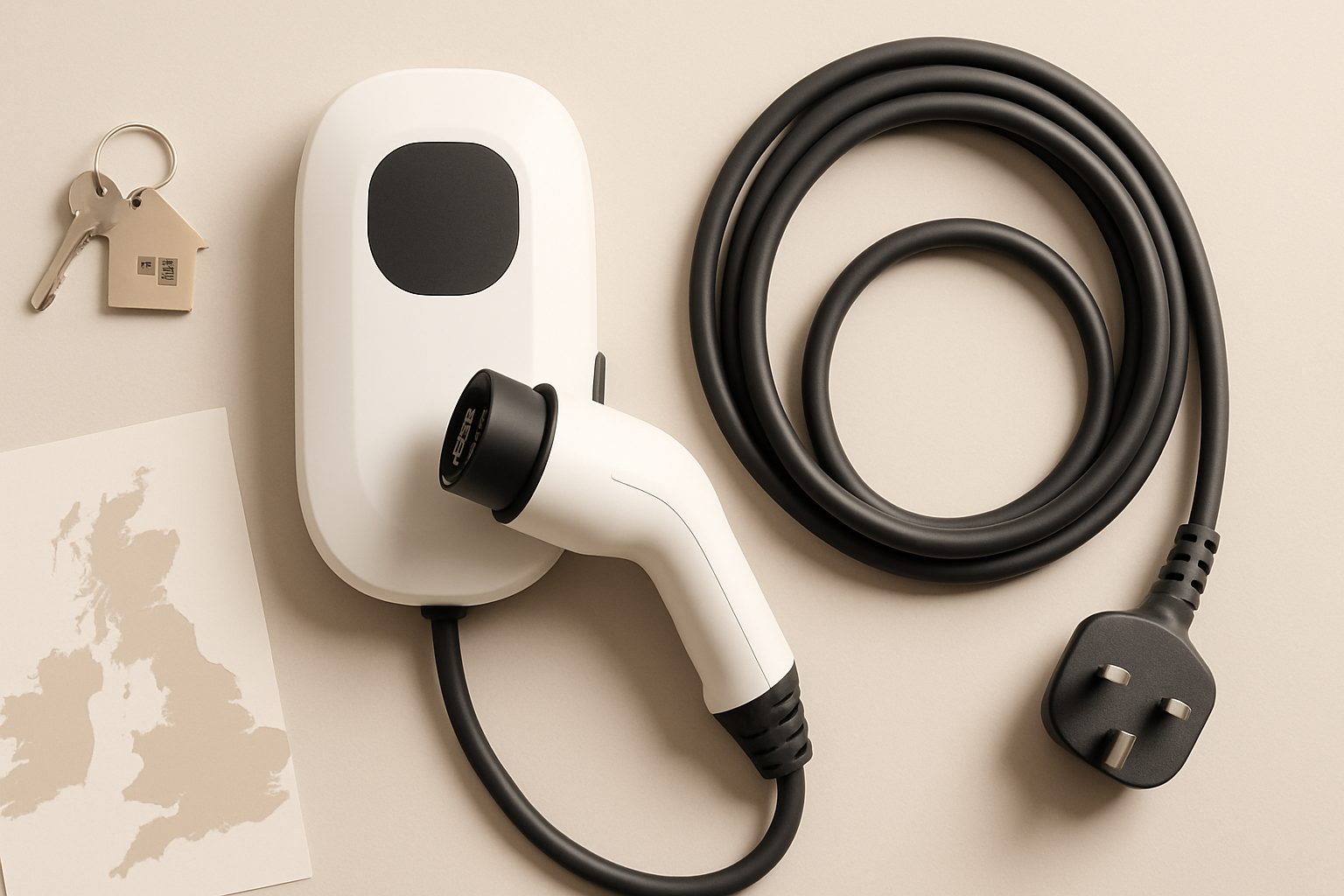
For most flat dwellers without access to landlord-approved fixed infrastructure, a portable EVSE (Electric Vehicle Supply Equipment) unit remains the most practical solution.
These are tethered charging cables that connect to a standard domestic 13-amp three-pin plug. They're compact, can be stored indoors, and moved between vehicles if needed. They charge slowly—adding about 3 miles of range per hour on a standard socket—but for many people, overnight charging covers their daily commute.
The main brands offering UK-standard portable units include Tesla, Zaptec, and myenergi. Prices range from £400 to £800 for reliable, safety-certified models. Look for units with appropriate IP ratings (weather resistance) and built-in safety features like thermal protection.
The key advantage is flexibility: you can use it at your flat, take it on holiday, or use it if you move house. There's no permanent installation, so landlord approval is usually straightforward—you're just using a plug socket they've already provided.
Practical Tips for Flat Dwellers
- Check your parking situation first. Can you reliably park in the same spot, or can you reach a cable from your flat window?
- Get written permission before buying any equipment. Even a portable EVSE should be explicitly approved.
- Invest in a cable extension if needed. Heavy-duty weatherproof extensions (3 or 5 metres) cost £50–£150 and are safer than daisy-chaining standard leads.
- Manage expectations on charging speed. Overnight 13-amp charging won't fully replenish every EV battery, but it's enough for most commuters.
- Join a broader charging network. Public rapid chargers and destination chargers (supermarkets, workplaces) become your backup for longer journeys.
The Bottom Line
Living in a flat doesn't rule out home EV charging, but it does require more planning than detached-house ownership. Your best bet depends on your situation: a wallbox (with landlord agreement and ideally LEVI funding) if you can get it, a communal charge point if your building moves toward that, or a portable EVSE as a reliable fallback that works almost everywhere.
The key is to start by asking your landlord, exploring the LEVI Fund if you're eligible, and then making a realistic assessment of your parking setup. Most flat-dwelling EV owners find a solution that works—it just requires a bit more legwork upfront.
More options
- Ohme Home Pro EV Charger (Amazon UK)
- Zappi V2 EV Charger (myenergi) (Amazon UK)
- Wallbox Pulsar Plus EV Charger (Amazon UK)
- Andersen A2 EV Charger (Amazon UK)
- Portable Mode 2 EVSE Granny Cable (Amazon UK)